Testing Center Success Stories
|
| |
Peter Byrne
Project Manager
Certification Offered
IC³ |
|
Employer
Digital Community Project
Location
Ireland |
|
"When DIT saw the quality and strength of Certiport IC³, they were delighted to include certification in the program." |
"Digital Communities" Built with Certiport IC³ Bridge Divide
Program offers hope to thousands of Irish citizens who need computing skills and experience to pursue higher education, find work
September 2008
Peter Byrne has a vision. In it, individuals without skills or jobs have access to education and opportunities. Neighborhoods without hope become re-energized and self-sufficient.
The world may want to follow the blueprint to Byrne’s vision, which is quickly becoming a reality. The Digital Community Programme—a plan that began in 10 small, underserved areas of Dublin, Ireland—has now expanded to serve more than 21 districts. Behind the success of individuals and communities now spanning the Digital Divide is exceptional technology, digital literacy training and Certiport® Internet and Computing Core Certification (IC³®), the world’s only globally recognized standards-based certification for fundamental computing and Internet skills.
BACKGROUND
Leading the way in technological higher education, Dublin Institute of Technology (DIT) is an accredited academic institution that confers universally accepted degrees. Several years ago, DIT began an initiative to place computers in disadvantaged inner-city schools. Forty-four schools were identified for the program, a partnership with Fujitsu Siemens Computers was established and students and teachers began receiving IT training.
Unfortunately, organizers soon discovered that when students and teachers left their classrooms and went home, they had no access to technology. As a result, the Digital Divide—the gap between individuals with regular access to technology and individuals without it—was reinforced.
PROCESS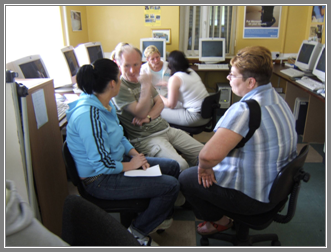
Without access to government funding or tax dollars, DIT partnered with Hewlett-Packard Development Company (HP), the Dublin Inner City Partnership, the Dublin City Council, Eircom, The Digital Hub and the National Centre for Technology in Education to create the Digital Community Programme. The program identified 10 of the most seriously disadvantaged schools and communities. In these areas, unemployment was as high as 87 percent, crime was excessive, illiteracy and lack of education was prevalent and individuals suffered from low self-esteem.
After each sponsoring organization assigned a senior-level, decision-making representative to serve on the Digital Community Programme board, a committee approached the communities to learn how members of the communities felt they could be serviced. "We turned the design back to the communities and asked what they wanted, rather than telling them what we thought they should do," said program manager Peter Byrne. "We needed their support and ideas to ensure they would use our services and engage in the opportunity we were providing them."
Byrne said the communities specifically stated that they did not want to be subjected to "never-ending training." Instead, they said, "We want jobs. We want real skills."
Next, the committee evaluated the best ways to provide the relevant skills needed. Several certification options were evaluated. "Not all of them were really current," Byrne said. Then, Prodigy Systems, a Certiport Solution Provider, introduced IC³. "When DIT saw the quality and strength of Certiport IC³, they were delighted to include certification in the program."
 Soon, six Digital Community Programme centers were set up in apartments provided with heat and electricity by the Dublin City Council, state-of-the-art computer equipment contributed by HP and broadband service provided by Eircom. Basic courses focused on keyboarding, computer usage and Internet usage were scheduled to slowly build the skills included in the three IC³ exams—Computing Fundamentals, Key Applications and Living Online—and, later, Microsoft® Office Specialist. Soon, six Digital Community Programme centers were set up in apartments provided with heat and electricity by the Dublin City Council, state-of-the-art computer equipment contributed by HP and broadband service provided by Eircom. Basic courses focused on keyboarding, computer usage and Internet usage were scheduled to slowly build the skills included in the three IC³ exams—Computing Fundamentals, Key Applications and Living Online—and, later, Microsoft® Office Specialist.
"We've developed a range of courses for individuals to up-skill themselves," Byrne said. "They can sit down and study IC³, or they can learn other ICT skills. The key is to provide the best, highest resources to build individuals' self-esteem. They don't use second-hand computers; they use the best equipment and services available."
As the program grew from 10 to 21 centers, Byrne said both the number of courses available and the participants wanting to attend them increased. "In some centers, we do not have enough capacity for those wishing to participate," he reported. "In 2007, 1,900 people attended courses, including participants of all ages—six to 76."
Each center is accredited through DIT to allow participants to earn university credit through the European Credit Transfer System. IC³ is worth five credits, and an accompanying teacher-training course is worth an additional two credits. "Individuals can transfer their credits to any third-level institute in Europe and use them toward degrees and as a pathway to their chosen fields of study," Byrne said.
In addition, Byrne said individuals who earn IC³ and complete the teacher-training course apply for the IC³ Authorized Instructor credential. Some are even hired back into the program. "We pay them to pass the skills on to other individuals in their communities," he said. They receive a starting teacher's salary of EUR 38. "This pay rate has a great impact on their self-esteem. We're giving them the jobs for which they asked, and their IC³ Authorized Instructor credential offers them an independent career outside of the program."
Each center is encouraged to become a Certiport Center, so it can self-sufficiently certify individuals. In addition, each center is required to have at least three IC³ Authorized Instructors on staff. Of more than 3,200 people who have participated in the program, 38 are now instructors on the payroll who are working at least 16 hours each week.
RESULT
After seeing the value of the Digital Community Programme in Dublin, Irish government officials, including Prime Minister Bertie Ahern, T.D. and President Mary McAleese's husband, Dr. Martin McAleese, have engaged loyalists and republicans to eliminate violence, promising to implement the Digital Community Programme in other areas as part of peace process.
Indeed, Byrne said government support has been helpful. President McAleese attended a Digital Community Programme graduation two years ago, at which 54 certificates were awarded to participants. Last year, Minister Éamon Ó Cuív, of the department of community, rural and Gaeltacht affairs witnessed the conferral of 58 certificates. In 2007, 121 individuals graduated from the program.
On an individual level, Byrne has seen lives transform, stories he finds "hugely satisfying." Speaking of his experiences working with single mothers, drug abusers and individuals with prison convictions, Byrne has met a number of individuals who have accomplished personal and professional goals through the Digital Community Programme, which has now expanded to 21 centers in Dublin and surrounding areas.
One young woman left school at age 14 and had five daughters before attending courses at a Digital Community Programme center. She now teaches courses for the program, and, following her example, all of her daughters want to attend college.
"To influence the next generation is key to the whole thing," Byrne said. "There is no other approach like this. We must engage people on their terms, not tell them what to do. They need to be consulted about what they want, and we need to be able to provide jobs to people who really need them and wouldn't get them otherwise."
Recently, after learning about the success of the Digital Community Programme, the department of community, rural and Gaeltacht affairs decided to provide ongoing funding for the program and give its own employees the opportunity to earn IC³. Byrne said this positive, commercial spin-off of the program demonstrates its influence in the government.
In addition, Digital Community Programme centers in Belfast and Belarus have opened, and Byrne is working with other countries to implement the program. "I always explain what we do by briefing people on our train-the-trainer program, of which IC³ is an established, important part," he said. Byrne hopes other cities throughout Ireland, the United Kingdom and the world will continue to emulate the program.
And, Byrne said, ideally, other certifications will become available. "We have just started bringing people through the Office Specialist program and other, more-advanced certifications. We are even looking at the possibility of including degrees in our programs. These advances will mean major changes to individuals and society and will have a major impact. Of course, we want to do it in such a way that the programs can be replicated elsewhere."
Without a doubt, Byrne's dream of individuals obtaining real jobs, real careers and university degrees while building self-sufficient communities is coming true.
ABOUT CERTIPORT
Certiport prepares individuals with current and relevant digital skills and credentials for the competitive global workforce. These solutions are delivered by more than 12,000 Certiport Centers worldwide and include Certiport Internet and Computing Core Certification (IC³®), the official Microsoft® Office certification programs and the Adobe® Certified Associate certification program.
"Certiport" and "IC³" are registered trademarks of Certiport, Inc. in the United States and/or other countries. "Microsoft, PowerPoint, Access and Excel are either registered trademarks or trademarks of Microsoft Corporation in the United States and/or other countries. The names of actual companies and products mentioned herein may be the trademarks of their respective owners. |